Dubai Escort Laws Explained: What Residents and Travelers Must Know
Dubai has one of the most visible hospitality and nightlife scenes in the Gulf, yet the escort market that operates alongside it in Dubai, Abu Dhabi and Sharjah sits in a legal grey zone that most visitors and residents never fully understand. Under UAE federal law, commercial sex work is prohibited, and the escort companionship category is therefore shaped by private, non-commercial arrangements and by the legal exposure that follows from them. Anyone searching for a dubai escort listing in the UAE needs to understand that the legal risk sits with the arrangement itself, not only with the emirate where it takes place. The platform DUBAILUST presents verified listings with real photos and discreet profiles in Business Bay, Dubai, and this article uses that kind of listing as a reference point for what a careful reader should check before any contact. You can visit the website to see how such listings are structured, but the more important skill is knowing how to read them critically.
Understanding the Legal Boundaries of Companionship in Dubai and the UAE
The starting point for any responsible decision is the federal framework. Prostitution and solicitation are criminal matters under UAE federal law, and their application does not depend on whether the activity takes place in Dubai, Abu Dhabi or Sharjah. This means that a "private arrangement" carries no automatic legal immunity. If money is exchanged for sexual services, the fact that the parties describe the arrangement as companionship does not change how authorities assess it. Courts and police look at substance rather than wording, which is why the language used in advertisements, the content of messages and the way payments move all become potential evidence.
The federal prohibition on commercial sex work applies in Dubai, Abu Dhabi and Sharjah alike, and the consequences fall on residents and visitors alike
- Cash-based arrangements increase risk because they leave fewer records for disputes and make it harder to show that no exchange took place for sexual services
- Keep communications short, factual and free of coded language
- Choose accommodation with clear policies, tell a trusted person your plans, and decide in advance what would make you withdraw
- A careful reader treats any listing as a set of claims to be tested, not as proof of a safe or lawful arrangement, and recognises that the safest decision is often to decline
The grey zone in practice is narrower than many people assume. Social companionship, such as attending a dinner or an event with a person who is paid only for their time and conversation, is treated very differently from arrangements that imply paid sexual services. The difficulty is that the boundary is drawn by the facts of each case. A written message that refers to rates for a specific act, a payment made in cash at the door of a hotel room, or a booking confirmation that lists services in coded language can each be enough to shift an arrangement from one category to the other. Anyone who considers a listing should assume that every message and every transfer may later be read by someone who is not sympathetic to the parties.
Exposure differs for residents and visitors, and the consequences are real in both cases. A resident faces the possibility of visa cancellation, deportation and damage to employment, since sponsors and employers can be affected by a criminal matter. A short-term visitor can face detention, deportation and an entry ban that prevents return for a long period. Hotel and building management are also obligated to report suspicious activity, so an arrangement that draws the attention of staff can trigger police involvement regardless of how discreetly the parties behaved. For this reason, discretion cannot be treated as a substitute for legal compliance.
Practical Problem: Verifying a Companion Before Any Meeting
Verification is the first practical filter, and it works best when you define your limits before you start. Decide in advance what you will share, which channels you will use, and what would make you stop. Keep a written set of rules for yourself, and make sure a trusted contact knows your schedule and general location. You should also know the reporting channels available to you, including the police and the relevant emirate-level authorities, so that you are not improvising if a situation turns hostile.
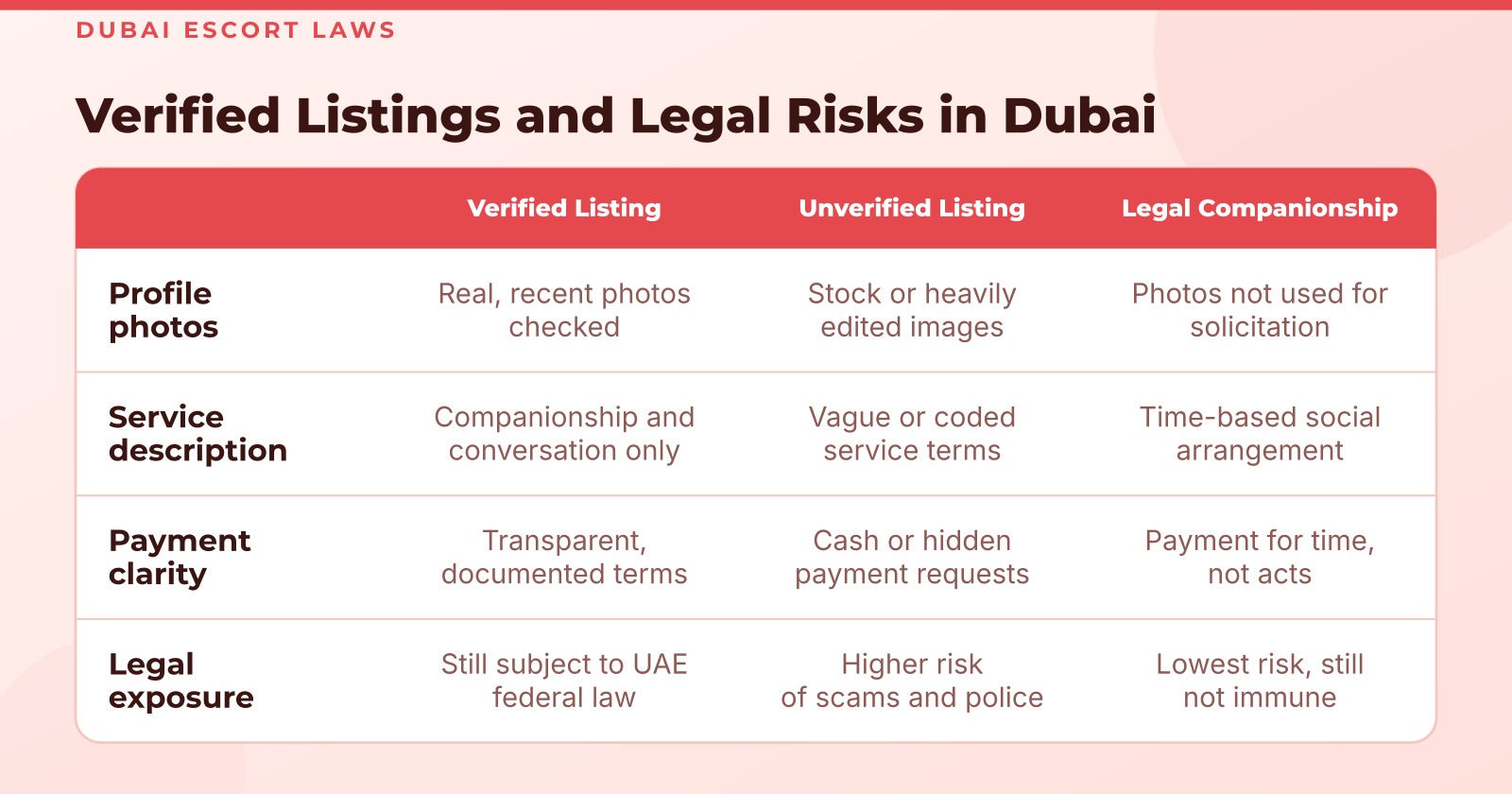
The verification sequence can be organised in four stages. The first is screening the listing for inconsistencies: photos that appear in several unrelated places, descriptions that change between versions, and urgency language that pushes you to decide quickly. The second is confirming identity and age through conversation rather than document exchange, since asking for a passport or residence card at an early stage is itself a warning sign. The third is a communication audit, where you observe how the person handles questions, refusals and boundaries. Someone who responds calmly to a "no" and answers basic questions plainly is showing a different pattern from someone who pressures you or treats every limit as negotiable. The fourth stage is logistics planning that does not require advertising your intent publicly or sharing your location with the listing before you have reason to trust it.
Red flags at each stage are specific and recognisable. Requests for upfront payment through untraceable methods, reluctance to confirm basic details such as the agreed duration or the location, rushed timelines, and third-party intermediaries who insist on controlling the schedule all deserve immediate caution. Green signals are less dramatic but more reliable: consistent information across messages, willingness to accept reasonable verification, and communication that stays clear and unhurried even when you are slow to commit. Neither set of signals proves anything on its own, but together they give you a basis for deciding whether to continue.
The most common mistakes are predictable. People rely on screenshots or reviews that can be fabricated or bought, which means they are not evidence of anyone's reliability. Others share personal identifiers, passport copies or residence details far too early, creating records that can be misused later. Many underestimate how payment records and message metadata persist, so that a bank transfer labelled ambiguously or a chat history on a shared device can be recovered long after the meeting. The most important distinction is between a verified profile and a verified person. A platform may review photos and text, but that review does not establish who will actually arrive, and you should not treat a badge on a listing as a substitute for your own checks.
Safety, Privacy and Digital Footprint Management
Protecting personal data starts with minimising what you share. Use an account that is not linked to your employer, family or other sensitive contacts, and avoid giving real names, addresses or workplace details in early messages. Be aware of how bank transfers, mobile wallet payments and messaging applications record activity. A transfer in AED is traceable by your bank, and bank monitoring systems can flag patterns that look unusual, such as repeated transfers to the same unfamiliar account or cash withdrawals that follow an electronic payment. Cash-based arrangements do not remove risk either; they simply move it to the moment of handover and to the parties' recollection afterwards.
Discretion in hotels, residences and transport depends on practical choices. Select accommodation with clear visitor policies, and understand that hotel staff have obligations to report concerns. In Dubai, Business Bay hotels and serviced apartments often have stricter access controls than older residential buildings, and in Sharjah social expectations for public conduct are tighter than in central Dubai. Transport and location choices can reduce exposure without creating suspicion, but attempts to conceal movements too obviously tend to attract attention. The aim is to avoid drawing notice, not to hide from the law. Read more.
If you face a threat, an extortion attempt or contact from the police, the first steps matter. Preserve evidence by keeping messages, payment records and call logs, but do not delete anything, since deletion can be treated as tampering. Stop further contact with the other party and do not make payments under pressure. Before making any statement to the police, speak with a lawyer who understands UAE criminal procedure, because what you say at an early stage can have lasting consequences. Extortion is itself a criminal offence, and reporting it is a legitimate step, but the timing and manner of reporting should be decided with legal advice.
Local Context: Dubai, Abu Dhabi, Sharjah and Seasonal Patterns
Enforcement and reporting vary in practice across the three emirates. Dubai's high-visibility hospitality sector, with its large hotel stock and dense tourist traffic, places heavy reliance on hotel security and on staff vigilance, which means that most incidents are first noticed at the property level. Abu Dhabi tends to have a smaller visible market and a more conservative public atmosphere, while Sharjah applies stricter community standards and is generally less tolerant of visible nightlife-related activity. These differences do not change the federal law, but they do change how quickly attention is drawn and how staff respond.
Seasonal and event-driven fluctuations also matter. The winter tourism season, roughly from late autumn to spring, brings higher visitor numbers and more hotel occupancy, which in turn increases both demand and the likelihood of scrutiny. Major exhibitions and conferences in Dubai produce similar peaks, with more travellers and more active hospitality staff. Ramadan tightens public-conduct norms during daylight hours, and venues adjust their hours and atmosphere accordingly, so arrangements that might pass unnoticed at other times can attract attention during that month. Planning around these periods means recognising that quieter weeks can be less risky in terms of attention, though they carry the same legal exposure.
Pricing and payment realities in AED deserve a clear warning. A quoted price in dirhams is not an indicator of legality; it is simply a number that can appear in a message that later becomes evidence. Electronic transfers are more traceable, which makes them easier to investigate, and both methods carry the risk that a counterparty will later use the payment as leverage. A rate attached to any arrangement should be read as a legal indicator in its own right rather than as a neutral detail.
Checklist: Criteria for a Safer, Lower-Risk Decision
A lower-risk decision starts with the law. Confirm that you understand that commercial sex work is prohibited in the UAE and that you will not discuss or agree to any payment for sexual services in writing or in person. Verify the listing through your own checks rather than relying on a platform badge, and do not share identity or residence documents before you have a reason to trust the other party.
Next, protect your data and your money. Use accounts and payment methods that you can explain, avoid upfront transfers to unfamiliar accounts, and keep records of what you have agreed. If anything feels rushed, unusual or inconsistent with what you were told earlier, stop and reassess.
The clearest conclusion from this analysis is that the legal risk of escort arrangements in the UAE is not reduced by careful wording, verified badges or discreet logistics. For anyone who is uncertain about where the line sits in a specific situation, independent legal advice is the only reliable guide, and it should be sought before, not after, any contact is made.